The Enlightenment and Primary Resources

Fordham University has a tremendous asset for your teaching of world history with tons and tons of links for every part of what you teach broken up into an easy to follow outline that looks like your World History I or II class.

For example, for the Enlightenment, here is a complete outline of all the major thinkers and links to their key writings.  You could have your students read excerpts or put them in groups and have them exchange with others what they have found.  

Add Questions for Students to YouTube Videos

You can add questions to any You Tube video if you sign up for the Beta test Google just started.  You can sign up by clicking here.

You can add questions (only multiple choice for now) anywhere in the video. You just scan through the video to the point where you want to add the question. When you play the video back, it pauses at the question, and will not move ahead until the question is answered correctly.

Here are more explicit instructions that I found on another blog.

Here's a short how to clip from another teacher. 

The Value Added By a Great Teacher

So perhaps this is a little off the normal target of this blog, but your hard work does pay off for your students.  Right now I am reading Unchartered which uses Google books to look at how language has changed over time (or at least at the point where I am reading).  But in the introduction Raj Chetty is referred to for his landmark study on the value added of a great teacher. Chetty earned the incredibly prestigious John Bates Clark award which often comes before a Noble Prize - and he is only 34!  At any rate the paper concludes that when a high value added (VA) teacher joins a school, test scores rise immediately in the grade taught by that teacher; when a high VA teacher leaves, test scores fall. Test scores change only in the subject taught by that teacher, and the size of the change in scores matches what we predict based on the teacher’s VA .. and students assigned to such high value-added teachers are more likely to go to college, earn higher incomes, and less likely to be teenage mothers. On average, having such a teacher for one year raises a child's cumulative lifetime income by $80,000.   Best of all the study is a quantitative one so it is not based on time based case studies so you can draw the inference that by reflecting and continuing to improving your craft you are really making a difference in the life of your students. 

Alexander the Not So Great: Through Persian Eyes

He destroyed the great capital of Persepolis and the temples and emblems of the ancient Zoroastrian religion. So, unlike Westerners who tend to see Alexander as a great conqueror and military genius, Iranians do not see him as so great.

In an fascinating article for BBC News Magazine, Iranian historian, Ali Ansari, professor in modern history and director of The Institute of Iranian Studies at The University of St Andrews, Scotland, suggests that Alexander came to regret the destruction he wrought in Persia. He believes that had Alexander lived, "he may have restored and repaired more" than he did during his life.

You can also listen to Professor Ansari on BBC4 Radio 4 in an an excellent  3-part series "exploring world history from a Persian perspective."  Each episode is about 30 minutes and offers some great history through Persian eyes. In part 1, Professor Ansari discusses Zoroastrianism.

Catching Cheating Using Technology

I like to think that when I teach I am embarking on an adventure with my students, but kids are kids and there are lots of pressures they feel from trying to impress their friends, pleasing their parents and, in some cases, not even being aware of cheating (plagiarism) - or rather never have been called on it.  There are lots of ways kids can cheat, but with technology it has also become easier to catch.

  1. Copying from the Internet remains the most prevalent cheating and the easiest to catch.  As I tell my students, most of them are paid to write and so as nicely as some of them can write, any time I suspect copying from the Internet (PowerPoints seem to be the place most likely to do this), I just paste in a line into Google and up it pops.  Usually if there is more than a line, I don't accept the assignment.
  2. Copying from friends is harder to catch, but using Google Drive there are several ways to catch offenders:
    • For each set of assignments, create a folder and drag in each assignment.  At the same time, right click on your "shared with me" stream and "remove."  The assignments will still remain in your folder.  
    • If you think you've seen a line in an assignment more than once then go to the search engine for the assignment folder (see above) any type in the "offending language."  As with searching the Internet any copied language will appear and instantly you can see where it originated.  If you partner with other students, have them create a similar folder and you can exchange lines.
  3. Use "revision history" by going to "file" and then "revision history."  
    • This will allow you to see how much your students have been working on a project which will appear on the right side under "revision history."  If there is only one entry either your students wrote it in Microsoft Word (and there you will have to decide if you want to "ban" using this or they copied it.  Either way it is a huge flag to tell that you need to copy a strand of the language into the search engine and see what you get.  
    • You can also see what time the kids were at work.
  4. If you are like me catching students is no fun and detracts from the team aspect of learning that we try to build in our classrooms.  On the other hand, make a point of nicely telling your kids how many kids have been caught.  Usually catching a few early in the year detracts from cheating the rest of the year and leads to better learning the rest of it.  Of course how you deal with cheaters is up to you and your school.  Here's to hoping these tricks detract from cheating. When my book comes out in the late spring I'll have more on these techniques, but more on that later. 


The Modern Revolution

 ,Here's a great review of the modern revolution from the Big History Project. The ingredients include globalization, new energy resources, the increasing use of energy and the inter connectedness of the four world zones.

History of St. Nicholas

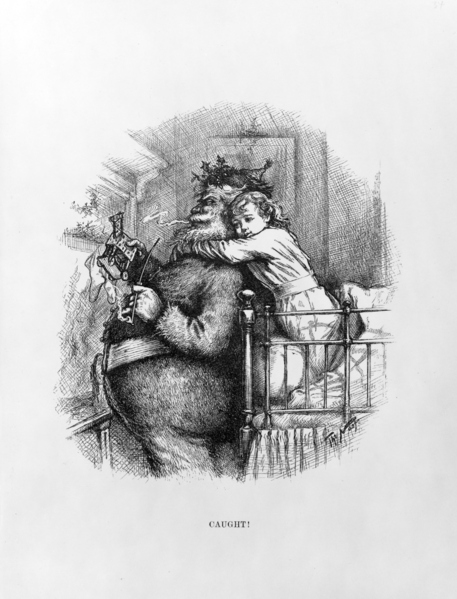
This is a great NPR interview about the reality of St. Nicholas who was a Catholic bishop from Turkey.  He actually was born wealthy and did give some of his money multiple times to poor families prior to being a bishop.  Legend (no real proof) is that on one of the visits instead of throwing it through the window (his usual method), he dropped it down the chimney.  There is a lot more in the interview.  Here and is a website explaining the history.

The history of the suit goes back to Thomas Nast's cartoon above. 

Cloud Based Video Maker


A few days ago a teacher in my department asked me how to make a video.  I spent 3 minutes with him on WeVideo and came back and in five minutes he had figured it out and created his short video.  It is that intuitive.  WeVideo can be done alone on the Internet or it can be added to your Google Drive account (Create (in the upper left side of a page)...Connect More Apps...WeVideo and then synch it with your account).  WeVideo is essentially a MovieMaker that is cloud based and therefore can be worked on simultaneously by a bunch of different people in different locations.  Think about how many times you have run out of time working on a video and wished the kids could finish at home.  Well now you can! 

Greek Philosophers: Can't Get You Out of my Head

Kylie Minogue reviews the three main Greek philosophers!

Archimedes Takes a Bath

Archimedes takes a bath and comes up with one of the great principles of mathematics in this great three minute TedTalk.

Egyptian Mummies: Great Flash Site

Here's a very cool interactive flash site from Active History that takes you through the steps of mummification in an engaging manner. Thanks to Russel Tarr for tweeting the link.

Pericles, the Delian League, and the Athenian Golden Age

Here's a great seven minute clip about the formation of the Delian League and the Age of Pericles.

The World's Largest Cities Over Time

Here are the world's largest cites from 4000 BCE to the present from Slate Magazine. They got the chart from Goldman Sachs who just published a report with their favorite 100 charts. This was one of them. If you go to their site here, you can click the chart and enlarge it.

You'll see, for example, that in 1000 CE, Kaifeng was the largest city in the east with a population of almost 1,000,000.  And Cardoba was the largest in the West with a  population of about 200,000.

Flipped School Clintondale's Videos

The PBS video on Clintondale in the post below is excellent especially since it addresses what to do with students who are more disadvantaged.  Both George and I have to deal with that in our schools.  One of the things I do is have more fluid due dates.  In fact my flipped students only have late assignments after the test is over.  I also have lots of kids come to my class during our "flex" periods, as well as at lunch and after school.  If you want to see Clintondale's videos go here. You can look a few posts below to see how to make your own videos.  If you want more I have a book coming out in the late spring with Corwin that spends some time on flipping the classroom - and a lot more, but more on that in coming months. 

What' a Flipped Classroom Looks Like

Here's an excellent clip from PBS NewsHour that shows what a flipped classroom looks like.

Google Sites for Education

Google sites is a great platform that allows you to create a class website where you can embed assignments, video clips, and even Google Forms for short assessments. Google gives you more flexibility than Blackboard and has more apps that work seamlessly with Google sites.

 My colleague, James Dahlgren, and I presented different ways to use Google sites at the 2013 VSTE (Virginia Society for Technology in Education) Conference in Roanoke this weekend. Here’s a link to our presentation that shows you the steps involved in creating a site.  And here's a link to a site we created for our AP World history class.  We link the site to Blackboard so that when students open Blackboard they are taken directly to the Google site.

From Foraging to Food Shopping

Did you know that the decisions you make about food today extends far back into human history? That's exactly what this clip from the Big History Project attempts to show.

42 Maps - Different Ways of Looking at the World


This is a cool look at the world through 42 different maps as told by Hank Green (brother of John).  Show it to your students when you start your map sections. 

Flipping the Classroom Presentation


I helped organize a technology 1/2 day at our school today.  I am doing a presentation on Flipping the Classroom.  Here is what we are going over today:

  1. What will be taught:  We will learn how to record lectures for students to watch at home, how students can be accountable for that information and how to flip one’s classroom to do the “problem sets” in the classroom.
  2. Tutorial steps that will be finished in the class (each underlined item is linked to a tutorial)
    1. will learn  how to use Screencastomatic to learn how to record a ten minute lecture
    2. will discuss what can be done in the classroom
    3. will learn how class activities can be put on a Google Drive document and linked into Blackboard
    4. learn how to split the laptop screen so students can see the video and their notes or you could use VideoNot.es (tutorial)
    5. If you accumulate lots of videos, here is how you create a youTube Playlist 

Google Drive Templates

My son is working on an assignment on Jamestown (4th grade history in VA is VA history) and is writing a newspaper account about 1619.   So we found this link to Google Drive documents' templates.  But it also has links to Presentations (PowerPoints), excel spreadsheets, forms and drawings (see below).

To use the templates, simply open up Google Drive and then go to the page.  Click on "use this template" (see below) and it will appear in your Google Drive under "Recent" which is on the left side of your page.

Greek Government


This is a nice video explaining how you can use paper to tell the kids about Greek government. 

Mandela's Struggle in Posters

The New York Times has a great slide show of Mandela's struggle against apartheid through posters. My thanks to Jeff Feinstein for sending me the link.

NPR's Planet Money Makes a T-Shirt

Show your students how a simple t-shirt is made. They'll be amazed! Click here to go to the NPR site (NPR developed the story), scroll down and click "View" for a video presentation of the story. The video contains different chapters such as "cotton," "machines," "people," "boxes," and "you."  It's fascinating and definitely worth showing,especially if you are covering the industrial revolution.

Here's part IV, about boxes

Scripts for Google Drive


Unlike apps that are added to something like Google Drive, scripts just help Google Drive further an application it already has.  For example, WeVideo is an app that one can use to collaboratively make videos in Google Drive.  But we have already discussed a script such as Doctopus that allows you to put your students' assignments in folders.  Well, here are eight other scripts that you might want to use in your classroom along with Google Drive.

The video above is one example of the scripts on the link which is called Flubaroo which makes grading exams easier in Google Drive forms.

I found the scripts on Synergyse.

Ancient Rome Prezi

Here is an awesome prezi on Rome. It begins with the rise of Caesar and the end of the Republic and goes through Augustus and Pax Romana. Five or six excellent short video clips add a lot of interest. Check it out.

Age of Exploration Poster

This is a nice concise poster that explains what life is like at sea for the sailors in the Age of Exploration (which for some reason is a difficult resource to get online). 

Holocaust Survivor Meets Savior


When possible I enjoy using primary documents as they bring history alive, but it is even better when one gets a short video like the great one above.  It shows two elderly gentlemen, one who was hidden by the other during WWII for being Jewish.  Perhaps since my own grandfather saved 200 Jews in Czechoslovakia from the Germans, I feel somewhat moved by the end of the video.  It would make a nice addition to your teaching WWII.  

Oracle Bone

My students were supposed to find out about the oracle bone, but a lot missed the boat so we will look at this simple site on Monday which does a nice job of explaining its purpose. 

World's Most Typical Human


We just finished our India unit and now are into China so I showed the bottom video to our students.  It is a great clip from National Geographic showing that the most typical person in the world is a Han Chinese man.  There is more to it and it is captivating to the kids.

The top video looks at what having seven billion people on the earth means and why are numbers keep going up.  It too will be enjoyed by your students. 

Da Vinci: The Lost Treasure

WETA will broadcast Tuesday and Wednesday a special about Leonardo Da Vinci. Hosted by Fiona Bruce, the BBC program will trace the story of the famous artist and help us to understand how he became so famous with so few paintings to his name.

Sailing the Seas of Global Trade

Follow Harvard historian Maya Jasanof as she explores global trade aboard an 1100 foot cargo ship as it sails along some of the same trade routes ships have traveled for centuries.  In a story for Aljazeera America Jasanof says that she is interested in the "links between the globalized past and present."

Joseph Conrad's "Heart of Darkness" provides Professor Jasanof with what she calls "a rich if unconventional historical source." Conrad, she says, "described the beginnings of globalization as we know it today: a world in motion and increasingly financially, politically and culturally intertwined; a world in flux, shaken by new powers, technology and ideas; a world whose dynamics strikingly resemble those of our own."

Here's the ship she on which she will be traveling for four weeks.Check Aljazeera for updates and photographs from Professor Jasanof as she begins her travels.

NCSS Breakfast Talk


This morning I am going to be helping my son's troop with their popcorn delivery.  Somewhere in the middle of that I am supposed to talk to the NCSS World History teachers' breakfast and hopefully call in for questions.  Since I can't be on my computer, I made this five minute video showing some of the cool things world history teachers can do.  

QR Generator for Google Drive

You can use a QR code generator for any of your Google Drive documents to use in your classroom, but if you want to keep a list of them, then you need to go to the Google site that will shrink your link and give you a QR code which it will keep for you as long as you want. 

Photos of Brazil's History With Slavery

Brazil was the last place in the America's to abolish slavery in 1888, so there are lots of photographs of the practice as you can see in the clip above. Indeed, according to NPR, Brazil has the "world's largest archive of photography of slavery."

Now, you can see many of those photographs  at a new exhibition in Sao Paulo (the museum web site is in Portuguese). You can also read the excellent  NPR story which includes some background about the history of Brazilian slavery.

We are covering sugar and silver in Brazil in AP World now so these photographs should offer students some interesting insights.

Here's the NPR story about the exhibit.

Kahn Academy's Smart History

I just found the Kahn Academy's "Smart History," which was started in 2005 and has now been quite well populated with both history and videos.  It started as an art history website, but has grown to be a nice history book or sorts with summaries, video and images.  It is broken into the major categories that you are teaching, be it ancient or modern world history.  

Amazing Summary Video of Major Religions


This is an eleven minute Ted Talk overview of each of the world's five major religions.  I would show each part to your students as a summary as it does a great job of giving your students the main points you are teaching.  But it adds in maps and ties the facts of each religion together very nicely. 

75 Google Play Apps for Your Classroom


A few years ago I met Jaime Casap whose job it is to promote Google's Chromebooks.   I found this PowerPoint from his Google+ account.  I will be mining it over the next few months, but wanted to share it right away as it has too many amazing apps for those of you who like to jump into these things right away.   All of the apps can be used on Chromebooks and with Google Driveand are found in Google Play. 

World History Teachers at NCSS

I recently have been in touch with Joe Ballou, the current chair of the world history community within the NCSS. Starting this year, NCSS is placing a greater emphasis on developing its support of world history teachers than it had in the past. If you're going to St. Louis next week, their world history community is hosting a talk and a breakfast (which I will call into to talk about technology) and I'd encourage you to check out both if you can. The community is also looking for NCSS members who would have an interest in leadership, as there are a number of volunteer leadership positions available. 

Joe is a former world history teacher who has spent the past 2 years creating world history games and technology with his company Civic Games, and currently works as a coach and curriculum developer at the Democracy Prep Public Schools. You should look out for him in St. Louis to talk about this work, or you can contact him directly via the contact form at www.joeballou.com

Cheat Sheets for Ancient World History

This is a great visual way to review for an ancient world history exam.  It has a visual summary for every major category you will teach.  Above is the one for China. 

Using Rubrics in Google Drive


So have you ever wanted to use a rubric with student work in Google Drive?  Sure you have.  You can create a rubric and then link it into Google Drive and have it connect to a Google Drive spreadsheet so that you can have the grades recorded and the students can see their rubric.  Above is the how to tutorial.  You can find more easy scripting on youpd

Doctopus to Manage Student Work Flow in Google Drive

One of the problem with Google Drive is that while you may want to keep all of your students' work, it becomes almost unmanageable in the shared column.  BUT Doctopus is a script that will allow you to create folders to put your students' work inside AND you will not have anything to show in your shared list.  Think about it.  You can then keep all assignments all year and check on cheating between different teachers (copy the curious language and then send a snippet to your fellow teachers and you can have them use their Google Drive search box to see if kids have copied between classes.

To use Doctopus, open up a Google Drive speadsheet and to to "Tools" and then "Script gallery"
and then use the search box to type "Doctopus' ." (steps are here). 

Next watch the video below to see how to use it. 


If you like this, there are many other items found here

The Origins of Civilization: China The Mandate of Heaven

Here's a great Michael Wood documentary about China. The first 15 minutes, which I plan to show tomorrow, cover Shang and Zhou China, Confucianism and Daoism. Michael Wood also produced the The Story of India, from which the clip in the post below came.

Flipping the Classroom Presentation

I helped organize a technology 1/2 day at our school today.  I am doing a presentation on Flipping the Classroom.  Here is what we are going over today:

  1. What will be taught:  We will learn how to record lectures for students to watch at home, how students can be accountable for that information and how to flip one’s classroom to do the “problem sets” in the classroom.
  2. Tutorial steps that will be finished in the class (each underlined item is linked to a tutorial)
    1. will learn  how to use Screencastomatic to learn how to record a ten minute lecture
    2. will discuss what can be done in the classroom
    3. will learn how class activities can be put on a Google Drive document and linked into Blackboard
    4. learn how to split the laptop screen so students can see the video and their notes or you could use VideoNot.es (tutorial)
    5. If you accumulate lots of videos, here is how you create a youTube Playlist 

Gupta Empire Achievements

Here's a clip from The Story of India about the Gupta achievements. I showed it today after students completed a History Alive station activity that reviews many of the achievements.

I helped organize a technology 1/2 day at our school today.  I am doing a presentation on Flipping the Classroom.  Here is what we are going over today:

  1. What will be taught:  We will learn how to record lectures for students to watch at home, how students can be accountable for that information and how to flip one’s classroom to do the “problem sets” in the classroom.
  2. Tutorial steps that will be finished in the class (each underlined item is linked to a tutorial)
    1. will learn  how to use Screencastomatic to learn how to record a ten minute lecture
    2. will discuss what can be done in the classroom
    3. will learn how class activities can be put on a Google Drive document and linked into Blackboard
    4. learn how to split the laptop screen so students can see the video and their notes or you could use VideoNot.es (tutorial)
    5. If you accumulate lots of videos, here is how you create a youTube Playlist 

Terra Cotta Warriors: Guardians of China's First Emperor

Here's a great overview of Qin's terra cotta warriors. The clip was for the 2009 exhibit of some of the warriors at the Houston Museum of Natural Science.

Confucianism and Daiosm: Great Podcast

Here's a great podcast explaining the basic beliefs of Confucianism and Daoism. I put it on Blackboard so my students could use it to review the two philosophies.
I helped organize a technology 1/2 day at our school today.  I am doing a presentation on Flipping the Classroom.  Here is what we are going over today:

  1. What will be taught:  We will learn how to record lectures for students to watch at home, how students can be accountable for that information and how to flip one’s classroom to do the “problem sets” in the classroom.
  2. Tutorial steps that will be finished in the class (each underlined item is linked to a tutorial)
    1. will learn  how to use Screencastomatic to learn how to record a ten minute lecture
    2. will discuss what can be done in the classroom
    3. will learn how class activities can be put on a Google Drive document and linked into Blackboard
    4. learn how to split the laptop screen so students can see the video and their notes or you could use VideoNot.es (tutorial)
    5. If you accumulate lots of videos, here is how you create a youTube Playlist 

Visualizing empires decline

Fascinating clip that's interesting not just for what it shows but what it doesn't show. Thanks to @CaseyMMeier for tweeting the link.

Another Chinese Dynasties' Song


Kudos to Jeff and George for finding Harvard professors singing the Chinese dynasties' song.  I like this one above best, especially the kid on the left whom my students get a kick out of seeing. 

Voice Comments in Google Drive documents


First off a clarification.  Google documents are one item in the Google Drive suite that includes things like Google forms and Google presentations, but now allow a lot of apps.  A new app is Kaizena allows you to add links (which you can already do), but also voice comments to a document so you don't even have to write anything anymore.  Above is the tutorial which I found from a Tweet from .

French Revolution Web Quest

Here's a great site that has links to short summaries of all the major events of the French Revolution from the Enlightenment to the fall of Robespierre. Each summary has a sidebar with supplemental information including images, documents, and some multimedia.  My colleague, Keri O'Brien developed a web quest that can serve as a great introduction or review of the big events of the revolution.

China's Dynasties: How to Teach Them

Two Harvard professors show us how to memorize the Chinese dynasties to the tune of Frère Jacques, a trick most of us high school history teachers also know.  It's just a little amusing to watch two older Harvard professors sing it. Thanks to my colleague, Jeff Feinstein,  who sent me the link to this video and New York Times story.

Buddhism Web Quest: Pacific Asia Museum

Here's a web quest based on the Pacific Asia Museum which has a great interactive website.  It works best with flash player. And here's the worksheet that goes with it. Thanks to my colleague,  Frances Coffee, who designed the web quest and sent me the link.

Attila the Hun: Here Comes the Rain Again.

Bookmark this clip for the Middle Ages. Here the Eurythmics sing "Attila the Hun: Here Comes the Rain Again." And below is the 1954 movie, "Sign of the Pagan," with Jack Palance as Attila. Read more about the movie from the Medievalists.net 


Salt: A Brief Big History on TV


Program your VCR for what looks like a great series. The H2 channel will premiere a 16 part series on salt this Saturday at 10 PM. The H2 channel is an extension of the History Channel. Here's how AP New summarizes the series: "The series uses science and history to show how various things that we take for granted these days had their origins thousands of years ago." Search "Big History" on the H2 channel to find the program.

undead decor

I have made my thoughts on Annie Sloan Chalk Paint clear - or so I thought.  But the Holocaust continues.  I have not done enough. 

The other day, I saw this fine specimen on craigslist:


It was $20.  I expect low prices for very-70s furniture, with or without a (very necessary) coat of paint slapped on.  So, $50 would be the cap for a reasonable price for this sort of thing, I think.  $20 is therefore a bargain.  It was posted yesterday, and I contacted the seller yesterday.  (I need something to sit under the antique cabinet in my laundry room...I think I've explained.  Anyway.)  Someone had already claimed it.  Hey, fair is fair - it's a great price, and that's a piece you can do a lot with.  I'm not complaining. 

Unless. 

Unless it was purchased by some idiot who thinks that if only it were duck egg blue, and then finished with dark wax, then it would be a precious heirloom worth $300

I comfort myself with the knowledge that these people cannot possibly be selling all of their wares at their ludicrous prices; but even the fact that they are trying is enough to irk me greatly.  And if that's what happened to this buffet (a bargain that I would have appreciated, and used in my home - rather than as the basis for a preposterous profit margin), then I am cranky indeed. 

And remember when I went on about how they tell you in their craigslist ad exactly what colors they used, and what type of wax, and that they specifically used the Annie Sloan brand of chalk paint, because surely your assessment of its beauty and usefulness is not dependent on how it looks or works, but on the materials they used to get it to that stage - remember that?  Of course you do. 

So, just to show you that you should never doubt me - this was advertised on October 26:


For $295.  Of course I'm not kidding.  Don't take my word for it - see for yourself

But then, on October 31, it was advertised again.  Here it is, five days later:


And the seller explains...

It's "[h]and-painted in linen and off-white colors then finished with dark wax for an aged look." 

What did I tell you about the dark wax???? 

Oh, by the way.  With a second color (and the dark wax!), it's $350.  I wouldn't believe me, either - you really need to see for yourself

This thing has to die out before it takes over all the furniture.  But it seems really difficult to kill.  Maybe it's one of those white-ash-stake-through-the-heart, skull-stuffed-with-garlic, buried-in-a-spot-where-the-moon-never-shines sorts of things.  I'm willing to do whatever it takes. 

The Biggestl Halloween Post in the History of the World

Let me start by saying that I am exhausted and more than a little happy that Halloween is finally over. It was fun, but seemed to drag on forever. It all started 3 weeks ago when Harley and her preschool friends attended a Fall Festival in Rockville, MD. (not pictured)  Last week all the kids went to a super fun Halloween party at a friends house. Yes, Nash is shooting icing directly into his mouth, completely bypassing the cupcake.

 
The next day our neighborhood had their costume parade.  By the way, Harley insisted on being Minnie Mouse, Nash a Jawa from Star Wars and Atley a fly. 


Pumpkin carving came as it always does the Monday before Halloween.


These little chocolate pies are one of my kids favorite treats because they can make them all by themselves with the mini-premade pie crusts, a box of chocolate pudding and whipped cream.
 
The next day we had a Trunk or Treat activity at our church.


Wednesday was Harley's preschool party at our house. Unfortunately, I didn't snap any pictures because I was too busy teaching but after school Harley taught the boys to play some of the games like Don't Eat Pete and Pumpkin Bowling.


As most activities in our house, even Pumpkin Bowling ended in a wrestling match.  I love the picture of Harley above when I caught her sneaking even more candy.
 
Thursday Halloween finally arrived.  Nash had a Halloween parade at his school, that I watched with Harley and Atley's class.  In the afternoon Atley and Nash both had class parties and of course Harley was right in the middle of it all.  Halloween evening we had some neighborhood families over for dinner. I served soup, bread, cider and some other fun things pictured below.  You will also notice that Harley tired of her Minnie Mouse costume and opted for a cowgirl costume instead.


Finally, ready for Trick or Treating!