
Summarizer

How Teachers Use Technology: Pew Research

- 92% of these teachers say the internet has a “major impact” on their ability to access content, resources, and materials for their teaching
- 69% say the internet has a “major impact” on their ability to share ideas with other teachers
- 67% say the internet has a “major impact” on their ability to interact with parents and
- 57% say it has had such an impact on enabling their interaction with students
My View on the Future of Education

Last week the Alliance for Excellent Education (which is the inspiration behind Digital Learning Day) asked me to write a blog post for them. If you care to read the entire post go here where I have a number of links to items my students have done this year to highlight my thoughts. But here are the money paragraphs:
One day all of our students will have interactive lessons where the teacher will walk around the room connecting information, helping pupils do their work and making sure that the necessary learning is being done correctly and where appropriate, collaboratively. Classes will be self paced and conclude with interactive assessments that measure students’ ability to find and use online resources to answer probing questions.
Before then we, as teachers, need to remember that the best way to educate students today is not the same way that we learned when we were students. We need to help move teachers away from lecture based assignments, urge them to change their teaching methodology to be one where multiple Internet based devices are acceptable in the classroom and finally how to recreate their classroom to meet the needs of our high technology learners. This will mean assigning easier material at home (flipping the classroom) and having more interactive assignments in the classroom. The focus of the room will change from the front to both increasing individual teacher-student contact as well as increasing interactions between students.
This is just a start. One day we will have algorithms to help drive instruction. My daughter Madison, for example, prefers to learn by video clips on Youtube while my son would rather read the information and figure it out himself. My other daughter Alexandra likes to do all her work in one sitting whereas Madison likes some breaks. Companies like Knewton are working with educators to create customized classes to meet these needs. But it will take more than cutting edge companies. If the FCC can create free bandwidth for everyone, it will positively impact my lower income students. Likewise, as we go to more cloud computing, we will be able to see lower price delivery devices such as the Chromebook which will mean that students will be able to bring their own laptop/tablet devices to school (as they are already doing with their smartphones) and will not worry about cost or theft.
How to Search by Reading Level
This very short video explains how you can do a Google search for an item and find the appropriate reading levels that would work for your students. I found this video from a G+ post from Google Gooru.
Seventeen Moments in Soviet History: an Online Archive of Primary Sources

The Cyrus Cylinder--2600 Year Old Icon Comes to US
The Cyrus Cylinder describes, in cuneiform, how King Cyrus of Persia defeats the Babylonian King (with the aid of Marduk, the God), Nabonidus. The cuneiform cylinder is housed at the British Museum but will soon tour five major museums, including the Sackler Gallery in Washington. In the video above, the director of the British Museum, Neil MacGregor, discusses the significance of the cylinder. My thanks to my colleague, Frances Coffey, who sent me the link to this story.
dilemma
So in my last post I mentioned that the next space getting my attention (yes, I've largely left the kitchen alone. No, it is not done. Well, it's kind of done. I don't usually do kind of done. It's mostly done. It will be done by the end of this decade. Is that reasonable?) is an area I have generally referred to as the sun porch. And that during my ministrations, it looked like this:

Which was true. I may also have mentioned at some point on this blog that I make fun of people who "just can't figure out what to do with" their spaces (how difficult is it to figure out what to put in your living room, really? Start with a couch you like. Proceed from there), and that, as usual, I am punished for my injustice by a watchful universe. Because I hadn't even realized that I didn't know what to do with this space until I came back from the Storage Unit of Doom (my mother's much-burglarized storage unit in the town where I grew up) with an antique library table she had bought, and realized that the (long and skinny) library table would go well in this space, and then realized that nothing goes well in this space and because I hadn't figured out what to do with it, or even noticed I'd neglected it, that it was rapidly becoming full of junk.
In my defense, I will note that this room is 5'6" wide and 20' long. Those are extremely difficult proportions, and, in particular, the 5'6" part is a nightmare. Not that most porches are enormously wide, but that if I'm going to try to decorate it as a room, well, rooms don't have proportions like that. I'd love to make it into an informal dining area with a long table, but even with the skinny library table and two benches, the space would be too narrow to allow anyone to walk past to get to a seat on the end. It just won't work. Obviously, a different concept is required.
So after I got that table in there, I resumed filling the space with garbage (I even painstakingly refinished the very-damaged antique table - and then started piling it with power tools, wood scraps, and sawdust. I am duly ashamed). The porch had the same ugly pink vinyl as the kitchen, and I was planning to rip that out and put in slate when I did the kitchen, as I am sure I've mentioned. And then the kitchen turned out to have those original floors, so the porch floor was next on the list. After which I was going to insulate the two exterior walls (the ones with the windows), and then chip the windows open (some idiot or idiots painted them shut), and then hire a plumber to hook up a radiator at the end there. Which would take it to fully functional. But I still had no idea what I wanted it to look like.
And then I found this ideabook on houzz. With CONSERVATORIES:
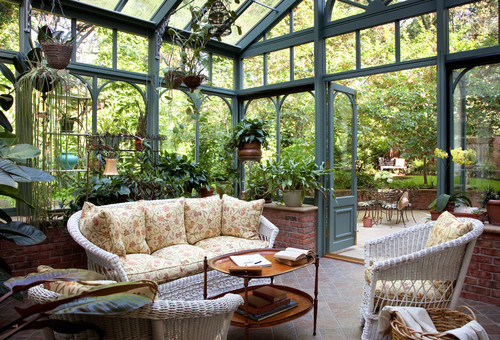
And the ideabook pointed out some things that I hadn't realized:
(1) "Conservatories were popular add-ons to the grand homes of the English aristocracy in the 19th century." I don't have a grand home. And there's certainly no aristocracy here. But my house was built in the (very) late nineteenth century, in a style (Victorian) that was drawn from English architecture. So, a conservatory would be appropriate, right?
(2) Conservatories "were originally developed to allow people to cultivate warm-climate plants, such as citrus, in cold climates." I manage to kill off everything I plant at an alarming rate. But I would really, really like to be able to keep a few herbs and vegetables alive, and, though I haven't even allowed myself to dream anything so grandiose (I am not allowed to plant ornamental items until I can keep the edible ones alive), I would love to have some roses and some lilies and some lavender. And I would really like a miniature orange and lemon tree of my own - I even saw a grower featured on This Old House a while back and tucked the idea away. Maybe if my plants lived indoors, I could keep them alive??? (Hasn't worked out for the basil so far, I admit. I just killed another one this past month.)
(3) Conservatories "were often used . . . as a place to collect exotic items gathered during travels." I had actually been tempted to for a sort of far-East motif in the sun porch, but I was thinking that would be a bad idea, because the rest of my house doesn't tend so far in that direction and I didn't want it to look "off." But if proper English manor houses had exotic furniture and taxidermied insects all over their conservatories, then maybe a little deviation from the rest of the house's decor would actually be appropriate. The wheels started turning.
I have some long-loved points of inspiration that will definitely figure into my plan. You all may remember this lovely image:

I had wanted to create a sort of "outdoor room" based on this idea, but that never got off the ground. (Apparently my ability to come up with a concept and execute it is entirely lacking where the outdoors are concerned.) I want to be realistic about what I'm likely to accomplish, after a collapsed trellis, dying outdoor lights, and several other inspirations that went south. I'm not going to come up with an actual outdoor room. But what about an indoor room that looks like one? My library table sort of has the right feel (though it isn't bleached wood):

(I cleaned it.) And I have these extraordinary chairs that I bought on craigslist last year. I've been using them for outside and storing them in the carriage house in the winter, but why couldn't they be on the sun porch instead?
They look like this:

I also have these two allegedly Swedish-style chairs:

They're on the porch already, but they're broken, so they're currently part of the junk. But now I am resolved to fix them. I also have these two gold-painted tables that I'm currently using as night stands in the second bedroom:

They have a sort of exotic feel. I could move them to the porch. And for our anniversary, my DH got me these lovely lanterns:
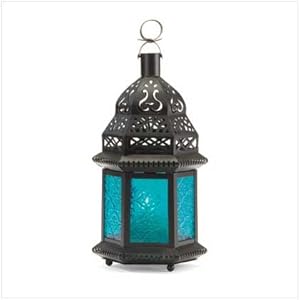
I have one each in blue, green, yellow, and red. They're already on the porch. They're sort of a smaller version of that lovely Moroccan castle-y thing in the inspiration photo, right? And I decided I also need some brightly-colored throw pillows, and I had a flash of genius: I would buy a pashmina and use it to make covers for some throw pillows. I found this one on sale for $5 this past weekend at A.C. Moore (of all places):

So I have a bit of sewing to do. It's just enough for covers for two 18" x 18" pillows.
I also have one other long-standing inspiration photo. A while back I saw a video tour of designer Martyn-Lawrence Bullard's California home (which is done entirely in an exotic/Moroccan style), and I fell in love with his porch/dining room:

(I just love him. And now Million-Dollar Decorators is no longer available on hulu, and I am sad.) But anyway, you see my point, right? I could embrace a little of this look (though tragically not a functional dining area). I've got the carved dark wood on the library table, and a little on the "Swedish" chairs, though not as fancy as his beautiful chairs. I love his ceiling, but I'm not planning to stencil mine (which is beadboard, by the way). I think his floor may be painted, too, though, and that is tempting. Because I started my own hunt for conservatory pictures, and came up with some lovely ideas. Including some that showed Moroccan-style tile on the floors, like this:

Although that is not the look I'm going for - doesn't have enough plants. Lots of plants are key:

And yet I am the death knell of plants. This may be an entirely uphill battle. So anyway...on the floor...I was thinking of maybe making my own stencil of this design:

I think I could execute that. I'm planning to use light gray, dark gray, and white (since those are the colors I have), but if I need something simpler, this colored pattern might work in gray:

Unfortunately, my darling husband for some reason does not want me to paint the floor. Instead, he suggested getting an oriental-style rug for that space. This makes no sense. Finding one in the right shape would be impossible, plus I wouldn't want to damage a real oriental rug in an indoor/outdoor space with all those (hoped-for) plants, plus my Moroccan tile inspiration is brilliant. Why can't he see that a painted rug is just better? I will have to convince him. I'm not going to just sneak a painted rug onto the floor. Probably.
Which returns us to the nitty-gritty. This past weekend, I did nothing productive on my little home improvements (I believe I re-hung my crucifix in the kitchen, using an existing nail hole. Grueling). My in-laws were visiting, and it was my birthday (thank you, thank you). Before they arrived, I had just finished removing the vinyl and luan from the porch, swept it, and cleared out a lot of the unnecessary crap. Here we are today:

You see the problem, I take it. Right here:

When I started removing vinyl and found the green-painted floorboards, I figured I was in business - and returned the last half of my cement backerboard (for the planned slate) to the store. I didn't make my way around to the other half of the floor until the end, at which point I saw that for some reason the porch was missing 40% of its flooring. I have no idea why. But as we have already demonstrated, I can patch missing flooring:

(And this time buying the wrong wood species won't matter, since it's going to be painted.) So this week, I rolled up my sleeves to return to the project. I figured I would measure the floorboards, spend the week finding the best price for the material, pick it up this weekend, and start in on the replacement boards, then move on to framing out and insulating a dummy wall.
There was no way to see this coming, but those floorboards are 2 3/8" wide. (And 13/16" thick, but I am going to pretend they are 3/4" thick because that is just ridiculous.) They are tongue-and-groove, and that's definitely what I'd like to use for the replacement - tongue and groove will shift much less than if I used "square-cut" (normal) lumber. So that's what I looked for - at Home Depot, and then Lowe's, and then Lumber Liquidators. There is nothing in that width. Not even materials I don't want. I called Lumber Liquidators today, and asked whether perhaps they sell strange things not advertised on their website. The nice lady cheerfully told me that all flooring these days is sold in 1/4" increments, and this is a typical problem with old houses, and she has no advice for me. (But she was very nice about it.)
I have just hit my first true "old-house" problem - not something that requires a big work-around (been there, done that), but something I really can't fix. I could rip my own 2 3/8" boards (if I had a table saw, which I would be willing to buy for a good reason), but I cannot realistically mill my own tongue-and-groove flooring. I am on the horns of a dilemma.
I could return to the plan of laying slate tile, in which case my husband may kill me, because he carried all the cement-board back and forth to the car three times and he was not pleased about my poor planning. (For the record, my planning was fine. The change was the floor's fault.) And I just returned to my colleague all the tiling equipment I had borrowed...and not used...for six weeks. Of course, that would also be much more expensive, and it would cover up the original, perfectly good...60% of a floor.
I also realize that if I'm going to paint the floor (whether or not I stencil it, though the stenciling might help conceal this), I could just stick with 60% flooring and 40% plywood (how the floor is right this minute). After all, the floor stenciling idea I originally stole for my stairs from this extremely talented lady was applied directly to plywood subfloor:

But if I do that, do I close all the seams between the floorboards, too? That will permanently hide the original porch floor. And, also, even if I insulate the porch, it will constantly be exposed to outside air, and I suspect that changes in temperature and humidity will crack any filler I put in there in short order.
ARGGGHHHHHHHHHH.

Which was true. I may also have mentioned at some point on this blog that I make fun of people who "just can't figure out what to do with" their spaces (how difficult is it to figure out what to put in your living room, really? Start with a couch you like. Proceed from there), and that, as usual, I am punished for my injustice by a watchful universe. Because I hadn't even realized that I didn't know what to do with this space until I came back from the Storage Unit of Doom (my mother's much-burglarized storage unit in the town where I grew up) with an antique library table she had bought, and realized that the (long and skinny) library table would go well in this space, and then realized that nothing goes well in this space and because I hadn't figured out what to do with it, or even noticed I'd neglected it, that it was rapidly becoming full of junk.
In my defense, I will note that this room is 5'6" wide and 20' long. Those are extremely difficult proportions, and, in particular, the 5'6" part is a nightmare. Not that most porches are enormously wide, but that if I'm going to try to decorate it as a room, well, rooms don't have proportions like that. I'd love to make it into an informal dining area with a long table, but even with the skinny library table and two benches, the space would be too narrow to allow anyone to walk past to get to a seat on the end. It just won't work. Obviously, a different concept is required.
So after I got that table in there, I resumed filling the space with garbage (I even painstakingly refinished the very-damaged antique table - and then started piling it with power tools, wood scraps, and sawdust. I am duly ashamed). The porch had the same ugly pink vinyl as the kitchen, and I was planning to rip that out and put in slate when I did the kitchen, as I am sure I've mentioned. And then the kitchen turned out to have those original floors, so the porch floor was next on the list. After which I was going to insulate the two exterior walls (the ones with the windows), and then chip the windows open (some idiot or idiots painted them shut), and then hire a plumber to hook up a radiator at the end there. Which would take it to fully functional. But I still had no idea what I wanted it to look like.
And then I found this ideabook on houzz. With CONSERVATORIES:
(houzz)
And the ideabook pointed out some things that I hadn't realized:
(1) "Conservatories were popular add-ons to the grand homes of the English aristocracy in the 19th century." I don't have a grand home. And there's certainly no aristocracy here. But my house was built in the (very) late nineteenth century, in a style (Victorian) that was drawn from English architecture. So, a conservatory would be appropriate, right?
(2) Conservatories "were originally developed to allow people to cultivate warm-climate plants, such as citrus, in cold climates." I manage to kill off everything I plant at an alarming rate. But I would really, really like to be able to keep a few herbs and vegetables alive, and, though I haven't even allowed myself to dream anything so grandiose (I am not allowed to plant ornamental items until I can keep the edible ones alive), I would love to have some roses and some lilies and some lavender. And I would really like a miniature orange and lemon tree of my own - I even saw a grower featured on This Old House a while back and tucked the idea away. Maybe if my plants lived indoors, I could keep them alive??? (Hasn't worked out for the basil so far, I admit. I just killed another one this past month.)
(3) Conservatories "were often used . . . as a place to collect exotic items gathered during travels." I had actually been tempted to for a sort of far-East motif in the sun porch, but I was thinking that would be a bad idea, because the rest of my house doesn't tend so far in that direction and I didn't want it to look "off." But if proper English manor houses had exotic furniture and taxidermied insects all over their conservatories, then maybe a little deviation from the rest of the house's decor would actually be appropriate. The wheels started turning.
I have some long-loved points of inspiration that will definitely figure into my plan. You all may remember this lovely image:
(houzz)
I had wanted to create a sort of "outdoor room" based on this idea, but that never got off the ground. (Apparently my ability to come up with a concept and execute it is entirely lacking where the outdoors are concerned.) I want to be realistic about what I'm likely to accomplish, after a collapsed trellis, dying outdoor lights, and several other inspirations that went south. I'm not going to come up with an actual outdoor room. But what about an indoor room that looks like one? My library table sort of has the right feel (though it isn't bleached wood):

(I cleaned it.) And I have these extraordinary chairs that I bought on craigslist last year. I've been using them for outside and storing them in the carriage house in the winter, but why couldn't they be on the sun porch instead?
They look like this:

I also have these two allegedly Swedish-style chairs:

They're on the porch already, but they're broken, so they're currently part of the junk. But now I am resolved to fix them. I also have these two gold-painted tables that I'm currently using as night stands in the second bedroom:

They have a sort of exotic feel. I could move them to the porch. And for our anniversary, my DH got me these lovely lanterns:
I have one each in blue, green, yellow, and red. They're already on the porch. They're sort of a smaller version of that lovely Moroccan castle-y thing in the inspiration photo, right? And I decided I also need some brightly-colored throw pillows, and I had a flash of genius: I would buy a pashmina and use it to make covers for some throw pillows. I found this one on sale for $5 this past weekend at A.C. Moore (of all places):

So I have a bit of sewing to do. It's just enough for covers for two 18" x 18" pillows.
I also have one other long-standing inspiration photo. A while back I saw a video tour of designer Martyn-Lawrence Bullard's California home (which is done entirely in an exotic/Moroccan style), and I fell in love with his porch/dining room:

(I just love him. And now Million-Dollar Decorators is no longer available on hulu, and I am sad.) But anyway, you see my point, right? I could embrace a little of this look (though tragically not a functional dining area). I've got the carved dark wood on the library table, and a little on the "Swedish" chairs, though not as fancy as his beautiful chairs. I love his ceiling, but I'm not planning to stencil mine (which is beadboard, by the way). I think his floor may be painted, too, though, and that is tempting. Because I started my own hunt for conservatory pictures, and came up with some lovely ideas. Including some that showed Moroccan-style tile on the floors, like this:
Although that is not the look I'm going for - doesn't have enough plants. Lots of plants are key:
And yet I am the death knell of plants. This may be an entirely uphill battle. So anyway...on the floor...I was thinking of maybe making my own stencil of this design:
(source)
I think I could execute that. I'm planning to use light gray, dark gray, and white (since those are the colors I have), but if I need something simpler, this colored pattern might work in gray:
(source)
Unfortunately, my darling husband for some reason does not want me to paint the floor. Instead, he suggested getting an oriental-style rug for that space. This makes no sense. Finding one in the right shape would be impossible, plus I wouldn't want to damage a real oriental rug in an indoor/outdoor space with all those (hoped-for) plants, plus my Moroccan tile inspiration is brilliant. Why can't he see that a painted rug is just better? I will have to convince him. I'm not going to just sneak a painted rug onto the floor. Probably.
Which returns us to the nitty-gritty. This past weekend, I did nothing productive on my little home improvements (I believe I re-hung my crucifix in the kitchen, using an existing nail hole. Grueling). My in-laws were visiting, and it was my birthday (thank you, thank you). Before they arrived, I had just finished removing the vinyl and luan from the porch, swept it, and cleared out a lot of the unnecessary crap. Here we are today:

You see the problem, I take it. Right here:

When I started removing vinyl and found the green-painted floorboards, I figured I was in business - and returned the last half of my cement backerboard (for the planned slate) to the store. I didn't make my way around to the other half of the floor until the end, at which point I saw that for some reason the porch was missing 40% of its flooring. I have no idea why. But as we have already demonstrated, I can patch missing flooring:

(And this time buying the wrong wood species won't matter, since it's going to be painted.) So this week, I rolled up my sleeves to return to the project. I figured I would measure the floorboards, spend the week finding the best price for the material, pick it up this weekend, and start in on the replacement boards, then move on to framing out and insulating a dummy wall.
There was no way to see this coming, but those floorboards are 2 3/8" wide. (And 13/16" thick, but I am going to pretend they are 3/4" thick because that is just ridiculous.) They are tongue-and-groove, and that's definitely what I'd like to use for the replacement - tongue and groove will shift much less than if I used "square-cut" (normal) lumber. So that's what I looked for - at Home Depot, and then Lowe's, and then Lumber Liquidators. There is nothing in that width. Not even materials I don't want. I called Lumber Liquidators today, and asked whether perhaps they sell strange things not advertised on their website. The nice lady cheerfully told me that all flooring these days is sold in 1/4" increments, and this is a typical problem with old houses, and she has no advice for me. (But she was very nice about it.)
I have just hit my first true "old-house" problem - not something that requires a big work-around (been there, done that), but something I really can't fix. I could rip my own 2 3/8" boards (if I had a table saw, which I would be willing to buy for a good reason), but I cannot realistically mill my own tongue-and-groove flooring. I am on the horns of a dilemma.
I could return to the plan of laying slate tile, in which case my husband may kill me, because he carried all the cement-board back and forth to the car three times and he was not pleased about my poor planning. (For the record, my planning was fine. The change was the floor's fault.) And I just returned to my colleague all the tiling equipment I had borrowed...and not used...for six weeks. Of course, that would also be much more expensive, and it would cover up the original, perfectly good...60% of a floor.
I also realize that if I'm going to paint the floor (whether or not I stencil it, though the stenciling might help conceal this), I could just stick with 60% flooring and 40% plywood (how the floor is right this minute). After all, the floor stenciling idea I originally stole for my stairs from this extremely talented lady was applied directly to plywood subfloor:
But if I do that, do I close all the seams between the floorboards, too? That will permanently hide the original porch floor. And, also, even if I insulate the porch, it will constantly be exposed to outside air, and I suspect that changes in temperature and humidity will crack any filler I put in there in short order.
ARGGGHHHHHHHHHH.
Book Reviews & My Favorite Book Ever
It has been awhile since I recommended any new books, the truth is I haven't read a ton of great one's lately with the exception of these three.

This book is a true story about one of the most amazing men in history. No, he isn't particularly famous but he survived one of the most horrific experiences during WWII and this is his story. It is unbelievable and inspiring. Loved it!

This book is not new (notice the 35th Anniversary Edition on the front) and it had been on my MUST READ list for a very long time and finally I got around to it. Again it is the true story of a Dutch woman who worked to help Jews in Holland during WWII. This is such a faith promoting book and an amazing reminder that if we look hard enough, we can see Heavenly Father's tender mercies even in the darkest of places and most troubling of days.
5 STARS

DRUMROLL please. Here it is my favorite book of all time. I think it even knocked out Pride & Prejudice. I know that is almost blasphemous, but this is an amazingly romantic, heart wrenching read. Set in England during WWI. Yeah, I am not sure what the WW theme is all about for me, but if you like Downton Abbey this is a very similar setting, but the hero and heroine are even more endearing than Matthew and Lady Mary. Again, blasphemous right. It takes a little time to become enthralled but trust me stick with it and read this book. Also, if you hate it, well, don't tell me because I might not like you as much anymore. Warning: It is little bit sexy-nothing graphic-but it is there.
Valentine's Butler Style...
was a whirlwind. I wouldn't expect anything less. First, 60 mini-cupcakes for Atley's class party and 30 pieces of cheese for Nash (egg allergy in the Kindergarten class).


Of course, Harley had to be my taste-tester. Then off to Atley's school party and then Nash's!


Next, Harley's preschool party hosted by yours truly! We decorated Valentine hats, (yes, that is just a paper plate) made love potion, sorted conversation hearts, exchanged Valentine's and more.


Harley decorated cookies with her main squeeze-Tucker.

After the boys got home the kids spent a little time in their favorite place-the hot tub. Nothing better on a cold day. I love the way the steam clouds around their heads on cold days.

Date night for mom and dad consisted of going to NRA headquarters to the shooting range. Fun times!


Exhausted anyone!! I know someone who was, she fell asleep at the kitchen table while eating her oranges.

Preview files in Google Drive

Google Drive now or will shortly allow users to preview files by simply right clicking on the file name. Free Technology for Teachers has a good story and some graphics to show you how to preview the files. The service will fully roll out over the next couple of days. It's a nice addition to Google docs.
Free Google Glasses
So for a moment, listen to my inner geek! Today Google announced that they are giving away 8000 Google glasses. These devices have the potential to change how we see the world literally - and cause more accidents until we all have self driven Google cars. As you can see from the video, the glasses let you call up a search, tell you the weather, how to get to a destination - can you say a computer in a light weight set of plastic glasses. If you want to apply for a pair, go here.
Morpho: Make Historical Perspectives


Morphu is an Ipad and Iphone app that allows you to import a photograph, edit it, and then record. The eyes and mouth move as you record. It's great for creating historical perspectives. I tried using it yesterday and it's quite easy and a neat creative app for the Ipad. Here's an example that another teacher posted.

Doceri iPad App for Your Flipped Class
I have been getting ready to use Doceri with my students when they receive their iPads. The app is like Educreations, but much more dynamic and allows one to create screencasts. We wil be using them since Google Drive's Presentation cannot be created on the iPad (only viewed). I also like it as it does not require a login/password. So my students will create them and then directly upload them into Google Drive and then share it with me effectively giving them a Presentation that can be recorded and annotated.
It is also useful if you like to write on your screen when you are making a flipped classroom presentation.
Doceri has a number of short videos on how to work the product, but each is missing an element. The best one to bring it all together is the one above.
It is also useful if you like to write on your screen when you are making a flipped classroom presentation.
Doceri has a number of short videos on how to work the product, but each is missing an element. The best one to bring it all together is the one above.
QR Codes
This is a nice video explaining how to make QR codes and even make them in a variety of colors. The post also mentions how you could create (see the pictures above) multiple QR codes on a page of paper (I just pass around one and have them scan it right away). It also shows how you can use QR codes to have students see multiple online pages, videos, etc. for a classroom assignment. I found this post on Edudemic.
More on ThingLink

I just ran across this ThingLink on classical composers linked to their music on YouTube. Click on the link and you'll see each musician linked to a YouTube video. It's very cool and made me think that this might be a nice project for SOL images in both World 9 and World 10. You can read my original post on ThingLink below.
MIT's Visualizing Asian Cultures

UTellStory: Multimedia storytelling and sharing

Free Technology for Teachers just posted this story about a new service called UTellStory. Sign up for a fee account, upload pictures, add captions or text, and narrate. It's like a slide show with your narration. The program gives you about 30 seconds of narration per slide and two minutes for total audio. It's a little like screen cast-o- matic. Students could create a news cast on a topic, narrate photos taken on a museum visit for extra credit, etc. Here's a sample story created by UTellStory.
Hairdresser Becomes World-Renowned Archaelogist
Guess you don't have to be a nerd to be a world-renowned archaeologist. A Baltimore hairdresser became exactly that when she saw a bust of Roman woman at the Walters Museum in Baltimore. She was blown away by the hair-do on the bust and tried to recreate it without success.
History books told her that it was probably a wig. She didn't buy that theory and began digging deeper, even questioning the translations of certain words regarding the hair. Eventually, she proved the archaeologists wrong and discovered that the hair-do was no wig and that with needle and thread she could re-create it. The rest is history. She's famous in the annals of archaeology now. This might be worth showing to freshmen when we discuss archaeology at the beginning of the year.
History books told her that it was probably a wig. She didn't buy that theory and began digging deeper, even questioning the translations of certain words regarding the hair. Eventually, she proved the archaeologists wrong and discovered that the hair-do was no wig and that with needle and thread she could re-create it. The rest is history. She's famous in the annals of archaeology now. This might be worth showing to freshmen when we discuss archaeology at the beginning of the year.
Using the WHII e-book
Today I am doing an in-service using our Patterns of Interaction e-textbook. Here is a short example of one of my upcoming assignments on Islam and here is a longer one on the Punic Wars. As with everything, I use Google Drive to make it.
If you use the Patterns e-book, you might want to look at these resources a team I led two years ago put together. It includes a how to video (see above) as well as a scavenger hunt for students and some assignments.
Finally, a very important thing is that you teach everyone how to split a computer screen so students can see both the e-book as well as a document they be writing upon.
If you use the Patterns e-book, you might want to look at these resources a team I led two years ago put together. It includes a how to video (see above) as well as a scavenger hunt for students and some assignments.
Finally, a very important thing is that you teach everyone how to split a computer screen so students can see both the e-book as well as a document they be writing upon.
Lots of Information on Starting a PLN

Punic War Video
Start this video at 2:35 for the first Punic War, but the earlier information is very interesting. My students will see this video from 3:20 to 6:20.
A Google a Day for Search Techniques

If you would prefer to see all the search tips right away, you can go here.
Interactive Online Maps


Subscribe to:
Posts (Atom)